the Ice
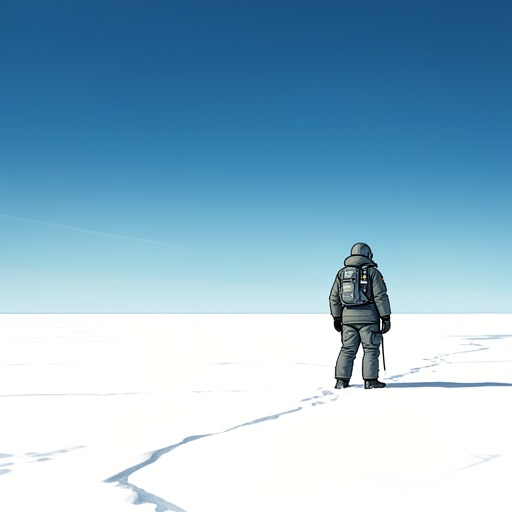
Where'd You Go BernadetteThe Ice is the narrator’s name for Antarctica’s frozen world, which changes from an abstract object of disbelief into an absorbing, almost overwhelming experience. Through icebergs’ scale, age, color, and presence, the expression marks a rare interval in which the narrator’s attention turns away from family and self and settles instead on the material world around her.
First Encounter
After two days of severe seasickness, the narrator wakes in Antarctica to an iceberg outside her window, three times as high as the ship and twice as wide. The sight is an immediate conversion: she describes it as love at first sight, bundles up, and becomes first in line when kayaking is announced. She wants to meet the Ice at close range, not merely view it from the ship.
Her encounter remains with the water and the icebergs. She goes kayaking but never sets foot on the White Continent itself. The distinction matters: this is an intimacy made possible by proximity, paddling among the formations, rather than by crossing onto Antarctic land.
Scale, Color, and Age
The narrator sees hundreds of icebergs, whose shapes summon cathedrals, shipwrecks, capsized cultural landmarks, carved hangars, and immense buildings. The comparisons make the unfamiliar landscape legible through built forms, while also emphasizing how ice exceeds the scale and uses of human construction. The bergs are tens of millions of years old, having calved from glaciers; their age and sheer size give them a history and presence independent of human observers.
Color becomes a discovery in its own right. Against the expectation that snow and ice are simply white, the narrator notices blue in many registers, from deep navy to incandescent and powdery shades. Her account combines sensory astonishment with newly acquired knowledge: Antarctica is a desert where it rarely snows, and an iceberg is a fragment of an ancient glacier. Scientific explanation does not dispel the wonder; it gives the wonder a longer timescale.
Attention and Stillness
The Ice changes the narrator’s attention as well as her view. She associates the bergs with sadness and wonder, but distinguishes these feelings from thoughts: her mind seems too emptied to think about her father, Bee Branch, or herself. She compares the effect to heroin, describing a powerful desire to prolong the state rather than return to ordinary concerns.
Human contact threatens to break that absorption. The narrator therefore goes out first in the morning and returns last, keeps her head down, stays in her room, and sleeps; above all, she simply exists without a racing heart or flying thoughts. The Ice is not only scenery in this account but the focus around which a temporary quiet becomes possible.
A World That Draws Her On
The narrator’s time in Antarctica is shaped by repeated outings on the water, including plankton-measuring excursions with Becky. When she learns that Becky is leaving for Palmer Antarctic Station, she hopes to accompany her, despite being told that civilians are not allowed and access is limited to essential personnel. At three in the morning, the paprika-colored RV Laurence M. Gould arrives, and the prospect of reaching the station seems to be slipping away.
That episode places the narrator’s Antarctic longing within a practical chain of vessels, supplies, and access restrictions: crates of fresh produce are loaded onto a Zodiac, and the narrator is mistaken for a scientist because of her excursions with Becky. The Ice’s pull thus belongs to a landscape that is not merely contemplated from afar; it leads the narrator toward further contact with Antarctica, even as the route onward depends on people and ships. The expression holds together the scene’s central contrast: an immense, ancient world that quiets the self, and a traveler still trying to find her way through it.